

Breaking the 20-Year Adherence Flatline: Why the "First Fill" is the New Healthcare Frontier
Despite billions of dollars invested in Patient Support Programs (PSPs) and clinical innovations, the core challenge remains: patients don’t always start therapy after a prescription is written.

For two decades, medication adherence rates have barely moved. According to the CDC and the American Medical Association, approximately 20% to 30% of first-time prescriptions are never filled or picked up at the pharmacy. Despite billions of dollars invested in Patient Support Programs (PSPs) and clinical innovation, the core challenge remains: patients don’t always start therapy after a prescription is written.
This gap between prescription and treatment initiation is more than a workflow issue — it’s one of healthcare’s most overlooked barriers to outcomes. Delayed or abandoned therapy contributes to disease progression, avoidable hospitalizations, and rising costs. Improving adherence means focusing on the critical period after a clinical decision is made but before treatment actually begins.
The First-Fill Opportunity
Improving outcomes starts with improving initiation. Life Sciences Companies spend billions of dollars annually to drive Healthcare Professional (HCP) awareness of new life-changing and life-improving therapies. However, the resources devoted to each additional new prescription (NbRx) does not always equate to a patient starting the therapy that is prescribed for them.
The window immediately after a prescription is written is one of the highest-risk moments in the patient journey. Access delays, communication gaps, and administrative friction can all prevent patients from ever starting therapy.
Reducing those barriers through connected digital engagement creates an opportunity to improve first-fill adherence rates and support patients earlier in their care journey.
The Digital Difference: Real-World Results
Nick Kleptz, PharmD, at the University of Cincinnati James L. Winkle College of Pharmacy, dove into the impact digital patient engagement can have on a patient's first fill, in partnership with Redi Health. The study found that patients invited to use Redi Health demonstrated significantly higher medication first-fill rates compared to standard care populations across both therapeutic areas.
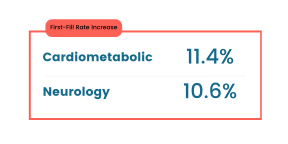
Both populations showed statistically significant findings. The intervention effect was observed consistently across every month evaluated, reinforcing the potential impact of real-time patient engagement during therapy initiation.
These improvements are meaningful at scale. For a pharmacy managing 1,000 new prescriptions, this level of engagement means more than 100 additional patients successfully initiating therapy.
Modernizing the PSP Stack
The solution to the 20-year flatline isn't replacing existing systems – it's strengthening the layer that connects patients to care during the moments that matter most.
- Simplify Access: Use tools that integrate directly with pharmacies and field teams to remove friction during therapy initiation.
- Whole Health Engagement: Go beyond medication reminders with education, lifestyle reinforcement, and personalized engagement that builds trust over time.
- Real-Time Visibility: Into prescription, prior authorization, cost, and refill status - so patients know what's happening and what to do next.
The future of healthcare won’t be defined solely by better clinical decisions, but by better follow-through. Closing the path between prescription and treatment initiation is one of the largest available opportunities to improve outcomes, reduce avoidable costs, and strengthen patient engagement at scale.
Redi Health is helping close that gap by turning points of friction into points of connection.
Based on a retrospective, real-world analysis of pharmacy fill data conducted in partnership with the University of Cincinnati James L. Winkle College of Pharmacy. Results reflect an observational study and may not generalize to all populations. See here for the full report.